Thursday, May 28, 2015

Days in a teacher's life


I've had an odd few days teaching. Over the years, I have had some bad and/or hard lessons and bad days, some my own fault, some external forces. Exactly two years ago, teaching the day my father died comes to mind as one of my hardest days. I've had problem students, even problem parents. I remember years ago one mother telling me I should hit her kid (who was only about 5) when he wasn't doing what he was supposed to in the lesson. I declined to do so, but I did once grab his arm and hold it rather firmly while I scolded him after he very intentionally punched me in the private parts and laughed. He didn't repeat that, or punch me at all after that, but I didn't need to hit him to get my point across. When I left that job he insisted his mother buy me a teddy bear as a goodbye gift, which I still have on my shelf.

Anyway, I have recently had a problematic student in two of my classes. My untrained assessment is he has problems with something along the lines of ADHD. Has had trouble following my lessons at all, even though they are rather basic and clearly laid out, trouble even staying in the room for the lesson. Has been repeatedly late or not shown up at all, and left the room suddenly on several occasions. Slept or played with his phone, didn't buy a textbook for either class. I talked with him about it at the end of last month, warned him he needed to change or wouldn't be able to pass the classes. Also offered to go talk with his advisor with him to be sure he understood. He declined, said he was fine, would be fine. After that we had a major quiz in one class and he couldn't answer a single question. The next week (last week) he was absent from both classes, and I thought he had given up.

This week he showed up, and finally had a textbook. I honestly didn't really have much patience left for him and wasn't happy to see him (class goes smoothly when he isn't there, not when he is), and I'm pretty sure in retrospect that he could tell. We did a review activity to start, which he had trouble with but which the other guys were helping him with. Then I did some stuff on the whiteboard, followed by a listening activity. While the listening was playing I turned my back and started erasing the whiteboard. Next thing I know, there is a loud crash and as I turn around I see his table is flipped over, he's violently thrown his pen case towards another student on the other side of them room (and it has shattered against the wall) and jumped up and gone after this other kid threateningly. He's accusing him of laughing at him and saying he should hit him, and as I try to get him to go back and sit down he starts yelling at me saying I never intended to give him credit for the class, that he should hit me, etc. In the process of then getting him to the student affairs office as that seems the fastest way to make the situation safe (but involves going several floors down and over to another building), we have more kicked-over furniture, him taking stuff from random people and throwing it either at me or towards me (not sure of his intent/aim), and then trying to restrain me from going into the office somewhat physically. Never actually punched or slapped anyone, but was very threatening and scary and did put his hand on me repeatedly. I was afraid for both my own safety and that of the other students.

It took some time (until the next day for me to hear the results), but the school ended up having his parents come (most 1st and 2nd year university students are minors under Japanese law and parents are their legal guardians), and there was agreement that there was a problem and that they wouldn't let him come to school any more. The school also agreed to change our classroom (at my request) and let the other students know by phone (not public notice) just in case he should decide to come back anyway. As I say, it was the next day before I heard the results, and that evening went home both traumatized by the event and concerned that they were not going to take him out of my classes. Spent a couple hours with my wife writing up all my notes on him into Japanese (I had basically had at least one problem with him every class that he had been there and had taken to making notes on it after the first week) as at that point I think I may have to go in and defend my stance that he should no longer be allowed in my class (as if the violent outburst alone shouldn't be enough).

Also, my wife was sympathetic on one hand, and saying she'd support me deciding not to teach there anymore if it came to that. On the other hand, she was kind of trying to make sense of it and talking about how maybe this was a way of him crying out for help and that he did it in my class because he sensed I was someone who would help, that I seemed like that kind of person. (She is a fan of this long-running TV show in which a high school teacher helps out his students who have all sorts of problems, but then that is a teacher who sees a small group of students every day and also has an expected duty of care compared to someone in my shoes who sees hundreds of students a week and usually for only 90 or 180 minutes.) So she ends up making me doubt myself and question if I could/should have handled him differently, been more sensitive and figured out what was going on with him, and start feeling guilty. As I write this it strikes me as just like domestic violence victims blaming themselves...wow!

Next morning I get up and shower, start getting dressed, and manage to throw out my back putting on my socks. It was sharp, brief pain, but I re-aggravated it a couple times in getting ready. However, I then was able to be careful and get through the day without setting it off again. But then yesterday morning it resurfaced, and much worse, and wasn't sure I was even going to be able to make it to school. I searched around and eventually found my back brace, which I haven't used in a couple years even when I have had issues, strapped that on, and took a couple pills in hopes that would get me though my morning of teaching. Well, it worked pretty well. The pills worked a little too well. Before my first period class I started getting a little loopy, and had to lay down for a bit.

Then I went to class, which is a really low-level conversation class. They had a conversation test, which involved them being called randomly in pairs up to the front of the room and then having to have a 3-minute conversation in English in front of their 30 other classmates touching on several topics we had practiced to this point. I was worried about probably a third of the class being able to complete it satisfactorily or not. As it turned out, only one or two stumbled significantly, most of them did it beyond my expectations (up to the standards I had told them I expected, though I internally doubted many would reach them), and a few were well beyond my expectations. I was so pleased with it that as I was telling them after they all finished that I was very pleased, I started tearing up. Not sure how much was the medicine, but anyway... My next class was a really high level class, where I gave them back grades from the previous presentation, which I wasn't as pleased with and had graded a little strictly. They were disappointed but also understood and accepted it. We had a good class, but I was a bit unfocused, and then had to rush out at the end for some lunchtime work. I later met one of the students who said they we're all wondering where I was going after that because I left quickly (I usually wait until they all leave the room first) and seemed really happy about something. Those meds were better than I expected, too...

Tuesday, March 4, 2014

My Passion and Curiosity Quotients

https://docs.google.com/presentation/d/1xE2K6AwtKN-uIwQvav-wde2AeeUX1_f5IAB3EzktqiE/pub?start=false&loop=false&delayms=3000#slide=id.p


Thomas L. Friedman, in an article titled, It’s P.Q. and C.Q. as Much as I.Q. (2013),
says that we now live in a hyperconnected and increasingly automated world which has had a significant negative impact on the labor force. These trends require people to continue learning new skills throughout life,  “skills that are complementary to technology”. He also says that what he calls “P.Q, (passion quotient)” and “C.Q. (curiosity quotient)” will be required to succeed in this new labor market. He doesn’t define these terms at all, but appears to be saying that we need to be both passionate and curious enough about the work we do that we persist with learning more and more about it and strive to continually create new ways of doing things.

So I asked myself, as an educator, what am I passionate about and what am I curious about? In other words, what do I hope to accomplish and what do I need and want to know to do this? Both lists continually evolve and could probably go on and on, but here are a few that came to mind.

I am passionate about:
  •  Getting my students to express themselves.
  •  Getting my students to read.
  • Getting my students to all see English as a tool for communication, not an academic subject to be “passed”.
  • Getting my students to be comfortable with themselves and to realize their potential.

I am curious about:
  • How to motivate my students.
  • How to facilitate communication.
  • How to reduce affective barriers to using English.
  • How to inspire my students to care and to act. 
  • How to use digital tools to help me do these things.

I was also asked in my CEP 812 class to reflect on the following questions: How do I use technologies in ways that demonstrate my passion and curiosity? How do I use technologies to inspire passion and curiosity in my students? For the former, one thing I do is read online. I also view video for information gathering, professional development, and pleasure. I use project management software in professional development activities and I study online. For the latter, I use authentic videos, STAIRs and WebQuests, I ask students to teach each other about presentation software and the pros and cons of using a variety of technology, and I ask students to record themselves with digital audio and digital video for self, peer, and instructor assessment.

Additionally, I was asked to “create something using something” (CEP 812 course instructions). I reflected on how to express these aspects of my P.Q and C.Q. in a creative way. I still believe in the power of text, the importance of writing ideas down so that others can read and reflect on them, and that writing is a creative exercise. However, I also wanted to challenge myself to expand out of my comfort zone and I wanted to use and consolidate some new skills to enhance my self-expression. So, I created a Google Presentation to show some of the ways I use technology to support and inspire passion and curiosity. Please have a look at it here.

References

Friedman, T. L. (2013, January 29). It’s P.Q. and C.Q. as Much as I.Q.. The New York Times. Retrieved on March 3, 2014 from http://www.nytimes.com/2013/01/30/opinion/friedman-its-pq-and-cq-as-much-as-iq.html?_r=0

Wednesday, February 26, 2014

Project-based learning and teaching to reinvent education

I recently had some reflective time as I sat, stood and walked around a classroom for several hours proctoring an entrance exam. I was not allowed to do anything else because I was there to stop any potential cheating. As I reflected on my own boredom and what a waste of my time this felt like, I noticed the tension, frustration and sometimes boredom among the examinees was also palpable. I found myself thinking this is exactly the kind of education gone wrong that my wicked problem project team (Megan Hess, Meagan Provines, Brittany Schroeder and myself) was considering how to change, and I spent some time reflecting on our discussions and goals.


We had talked about promoting project-based learning, particularly things that are or could be tied, and applied, to the “real world” both during and outside formal education. We had also pondered some issues related to assessing these skills. During my reflective time during this standardized test, I concluded that assessing based on project completion is closer to what learners will face throughout life than standardized aptitude or achievement tests. Once out of school, most people don’t encounter many, if any, of these kinds of tests. However, most people do find themselves judged on the things they accomplish, how well they work with others, things they are able to produce. Even for those who stay in academia, it is the quality of one’s inquiry and of the presentation of one’s processes and results that they are judged on, not taking standardized tests. The reflective, collaborative project is a model that applies to people in many different fields and endeavors and deserves greater attention in education. See the embed below or click the link to see our Reimagining Education Project regarding promoting greater inclusion of project-based learning and teaching.


As I wandered around the examination room I also reflected on what skills people need to accomplish these kinds of projects, skills that educators should strive to develop in learners. I came up with this list off the top of my head: working with others (both leading and contributing to a team), self-expression (multi-modal), persuasion, negotiation, critical thinking (including rational evaluation, critical reflection on outcomes), working to deadlines, and life-long learning. It dawned on me that this is exactly what the CEP courses have been doing!

Click to be taken to our project presentation.

Thursday, February 20, 2014

Survey of technology integration among colleagues


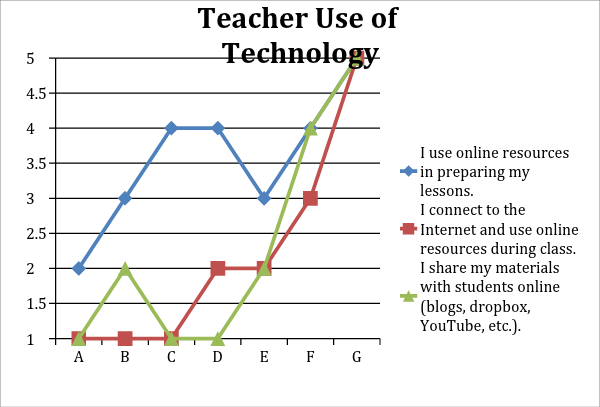
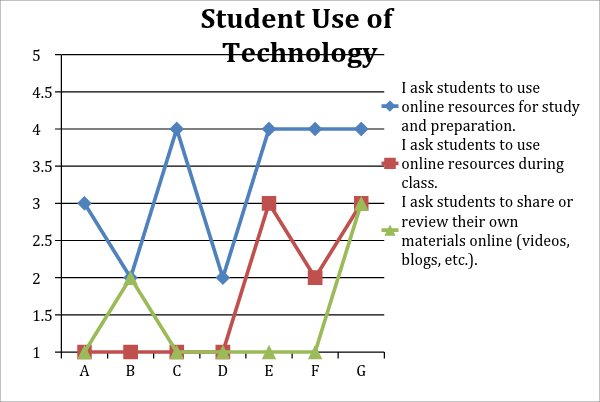
This week I was asked to consider my community of practice and the culture of technology integration in our teaching. My community of practice has a couple of distinct circles. One is the English Education Center in which I work with nine other full-time language instructors, then there is the university as a whole, next there is the wider community of language teaching professionals in Japan, and so on. I conducted a short survey of the other teachers in the closest circle, and this report discusses the results from the seven responses. Embedded below are infographic teasers of some of the results.

How the instructors currently use technology.


How the instructors ask students to use technology.


How comfortable the instructors report being with using technology in their teaching, how much they would like to further integrate technology, and how satisfied they are with available technology and support.


Excerpts of answers to open ended questions.
(Questions are on the darker circles, in royal blue text. Differing colors of text within a question's responses represent different instructor responses. The same response color in different questions is not indicative of being the same particular individual.)

Voicesofteacherstechusesurvey title=
easel.ly

The full report is available at this link.

Monday, February 17, 2014

Pinpricks through the bubble


This week we started from the assumption that digital tools and information can help us engage in meaningful inquiry and action, such as described by John Paul Gee and Henry Jenkins. You can watch this video of Henry Jenkins discussing his own thoughts and see my previous post, (or even better, Gee’s book, The Anti-Education Era) for more details about Gee's ideas. We also were informed that the Internet, while providing us potential access to a huge variety of information, is actually being mediated and filtered by algorithms that, coupled with our affinity for information that confirms our world view (see Gee, 2013 for more on this “myside bias”), is creating personalized information bubbles, our own “web of one” as described by Eli Pariser (in this TED talk). We were asked to examine and expand our digital information diet related to our profession, and reflect on how the changes influenced our perspectives. I faced three major challenges in this:
1. identifying what kind of information challenges my perspectives,
2. identifying sources that provide this information,
3. noticing any meaningful impact within a few days.

Figuring out what kind of information challenges my professional assumptions was my first task. In political terms, it would be easy, and I can quickly identify some regular posters in my Facebook and Twitter networks who challenge my perspectives. However, in professional terms it is a bit harder to sort out what my personal biases are since I tend to be surrounded by a lot of practitioners who share the same perspectives. Upon reflection I did come up with a short list of perspectives I don’t agree with; that the grammar-translation method of language education is good, that “no child left behind” policies improve educational outcomes and accountability, and just generally the policies of the Japanese Ministry of Education, Culture, Sports, Science and Technology (MEXT).

The next challenge was finding sources of information that I could add to my information feed. My regular digital information diet related to my professional life tends to be from mail lists and groups, individual mail, and, in the last few months, Facebook. So, I stepped outside the assignment a bit and choose Facebook as I use that more consistently than Twitter and I don’t use an RSS feed. MEXT has an offical page in Japanese, which I added to my feed. However, my reading in Japanese is limited. I did also look at some of their reports in English, such as this one on directions in English education. For No Child Left Behind, I found this page, which, while displaying a government logo, seems to actually be individuals dedicated to discussing these issues. I doubted it would challenge my perspectives, but did connect to it because it has the potential to inform them. I found a number of pages clearly in opposition to NCLB, but in terms of official government information I was left looking at reports on a web page. For grammar-translation method, I found an interest page, but no active support page.

Sadly, I don’t feel like the third challenge has really been met. The document on the future of English education has led me to think a bit less negatively about all MEXT directives and think they might actually be heading in a good direction with it. I have been inspired to try to get more information about it moving forward. Nothing has popped up in Facebook yet related to NCLB, but I am looking forward to getting more informed about how those policies actually are shaping education in the USA.

Monday, February 10, 2014

Exploring reading and assistive technology.


This week I was given an assignment to explore a special learning need. I have found this assignment somewhat frustrating on two fronts.
First of all, I was expected to research a need that I feel has relevance to my teaching context. However, in my situation I do not encounter students with identified special needs. My impression is that this is largely because these students are either identified but streamed away from university or not identified and therefore don’t receive support. In the latter case it is probably common that they underachieve at earlier stages of education and subsequently don’t try to attend university. However, given the severe demographic pressures on enrollment at Japanese universities, I do think that some students with learning disorders are being admitted. However, they seem to be unidentified, and not provided with any specific institutional support. I did think that my research could possibly help me be at least aware of who those learners might be, and since I teach a lot of reading I decided to focus on reading disorders.
Secondly, an element of this assignment is to experiment with assistive technology to help with this special need. While I was able to identify through web searching quite a number of possibilities, and was already familiar with some text-to-speech applications as well as audio-books, getting hands on experience with some of the more promising technologies was not possible because they are commercial products which I don’t have the funds to purchase.
With an understanding of those frustrations, please have a look at this short paper for more information on this topic.

Below you can also see a short presentation of what happened when I was looking for technology to experiment with.

Tuesday, January 28, 2014

The Anti-Education Era (Part 1) response

I have been told I am pretty intelligent, I have had a fair bit of formal education, and I know I have gathered some wisdom from experiences over the years. However, I am also stupid. I have made, and continue to make, stupid decisions in my life. Decisions related to every-day mundane things, to relationships, in the workplace, even that decision to finally use the right lane to zoom past that car that had been slowing me and irritating me. I instantly knew that last one was stupid because I had been warned state troopers often waited in that area for speeders and as I went by one popped out and pulled me over. Maybe you are shaking your head in agreement, or saying, “So what, we’re all stupid.” Well, in a sense, that is what this James Paul Gee book I am reading, The Anti-Education Era, is all about. He discusses how and why humans are often stupid when it comes to dealing with complex issues. In this short reaction paper for my CEP 812 class I discuss some of what he has to say in the first part of his book. Next time around we’ll look at how he thinks we can be smarter, so don’t let it get you too down!

Sunday, January 19, 2014

Complex ER Problem (for CEP 812)

I have a problem in my EFL Reading courses at a university in Japan in getting my students to self-select level-appropriate reading material for extensive reading (ER). What I have done to date is give them a general introduction to the concepts in ER, general guidance as to where I think they should start to find the right level of reading materials (including both bringing materials into the classroom and taking them to the library to explore materials), and then monitoring their choices and doing individual consultations until they get zeroed in. However, since the time for checking with them is really limited, this can take several weeks to get all students on track. Also, they may sort out that Level 1 for a specific publisher's graded reader series suits them, but then another publisher's level 1 may be quite a bit more difficult. What I have found, the Extensive Reading Foundation's Online Placement Test, looks to improve and shorten the process of getting my students aware of their own levels and how their individual level corresponds to several graded reader series. Have a look at this screencast for some more information about it. (If video does not display properly, follow this link.)

Unable to display content. Adobe Flash is required.

Tuesday, October 29, 2013

Solving Complex Problems (for CEP 812)


I had identified a problem in one of my courses and found a solution, Haiku Deck, that seemed to work for it. I started writing it up and preparing my screencast and then I noticed a major problem. I had thought that the iPad app would be fully functionally with iPhone, which would have helped solve the problem. However, I noticed the iPhone functionality is limited, so I needed to change gears and examine another problem.

I do have a complex problem with quite a number of factors. While it isn’t directly teaching, it is intricately involved with my professional practice. In this screencast I describe the problem and the tool, Zoho, which I hope will help solve it.
Unable to display content. Adobe Flash is required.

Sunday, March 3, 2013

CEP 811 Final Reflection


This course has helped me to consider more carefully how and why to integrate technology into my educational practice.  What stands out most for me is the work we did with respect to Universal Design for Learning (UDL).  Thinking about educational technology as something which can help open up more learning opportunities for all students was an interesting element and some of what I encountered there seems directly applicable to second language learning.  Making sure that using technology actually adds something useful that wouldn’t be possible without it also is an important concept I took away from this course.  The practice evaluating technological resources, including my own and those developed by my classmates, using the UDL and TPACK principles helped give me skills to continue to do this when finding or creating resources for my own classes.

Coming into this course I was pretty open to anything that might help me to improve my courses.  The fact that I have now got a webpage built that I can use for my courses in the new school year alone would be satisfying.  However, I have also managed to create a WebQuest which I expect will greatly enhance a major unit and help students achieve a couple of significant goals in one of my courses.  In addition, I have developed a STAIR which will aid in my reading courses.  Through developing this resource I have also been given a couple of opportunities to present about it to other teachers.  So I would say that I have not only met but significantly exceeded my goals for this course.

Creating things that expand on and support what is possible in direct, classroom-based instruction is what I would like to be able to do more of and more skillfully in the future.  My immediate plans to this end are to continue to improve and expand on the resources I have described above and to take CEP 812.  I hope that these steps will then lead to further development I have not yet considered.

Thanks to my instructor and classmates who made it all work!

Monday, February 25, 2013

F2F Instructional Strategies

I had an interesting experience today while exploring F2F resources for my course.  One of the technologies I was looking at was VoiceThread.  This is an interesting resource that allows one to make slide shows and collaborate on a conversation around these shows.  People can comment on / participate in these in a number of ways including text, voice, and video and then share them around the world.  It seems like a great resource for allowing EFL learners to connect and practice with learners around the world.  When I linked to the the ESL / EFL section here, I immediately found one example produced by someone I know from being officers in the same professional organization in Japan.  Then, as I explored further, I found one that the creator credited the idea for to someone by the same name as someone I used to work in the same school, live in the same building, and sometimes go to the same pub with.  I followed the link to her original material and then her blog and found it was in fact her, which provided me with an opportunity to reconnect with her.  Interesting how small the world can be!

Saturday, February 23, 2013

Reflections on Online Teaching


I would like to address this topic in two parts.  First with some reflection on the general topic based on the readings and my experience in my own teaching context in Japan.  Then I’ll turn to one of the resources noted in the Michigan Merit Curriculum Online Experience Guideline Companion Document and reply to the questions.

1. Generally relating online teaching to my teaching context.

I think there are much more limited opportunities for online experiences in Japanese institutions than in Michigan schools.  Where it is being offered it seems to most often be individual instructors or small groups of instructors who are doing it in their own classes or a small set of courses and this is mostly blended learning. However, some institutions are starting to offer teacher-led online courses.  My impression is this is driven more by a desire to expand the pool of potential students, particularly non-traditional aged students and part-time students, than a desire or plan to build technology skills.  These types of learners are accommodated very poorly in the traditional brick-and-mortar courses but are a growing percentage of potential students especially with the age-demographic realities in graying Japan.

I am actually not sure if my university offers any information or training on online citizenship and security.  I do know that during orientation there is an introduction to using the system and students get accounts so they can use the on-campus computers, which is more than at my previous school.  There is no Wi-Fi on campus and only teachers, not students, can connect their own computers to the Ethernet and then only with the IT office having registered and approved the computer.  There don’t seem to be any campus-wide directives or objectives similar to the MI initiative.  Some departments do require a computer course but usually it is based on learning to use Office software.

Online research and online resource evaluation training seem like they would be very valuable for our students.  Students generally are comfortable finding something (and, sadly, copying it) from Wikipedia or doing a basic Google search, but don’t seem to expand beyond that into checking multiple sources, checking the original sources and validity of what they do find, etc.  The Online Experience Guideline Companion Document has a lot of resources in these areas I plan to share with others in my English Education Center.

I think many of the design standards described in the Guide to Teaching Online Courses (pp.6-7) have not made it yet into the general curricular standards though I would say that many language teachers do strive to meet them.  Courses being learner-centered and collaborative, fostering skills rather than only content memorization, and being flexible in both coursework and assessments to accommodate the varied backgrounds, needs and learning styles of students are areas that I feel there is a lot of attention to in the language teaching community but not necessarily at the institutional or regulatory level.  In fact, some polices implemented to make sure educators and students are held to standards can actually run counter to these goals.  As noted in The Future of Learning Institutions in a Digital Age,
… traditional learning institutions, whether K–12 or institutions of higher learning, continue to privilege individualized performance in assessments and reward structures. Born and matured out of a century and a half of institutional shaping, maturing, and hardening, these assessment and reward structures have become fixed in place. But they now serve also to weigh down and impede new learning possibilities. (p. 24)
An insistence on formal final exams which account for at least 25% of the grade is an example of this in some institutions in Japan now.  On the other hand, there is a long-held assumption that a course in any format is to be teacher-led, and there is a recent push from regulators to be certain that course standards are made clear and that even university teachers should be expected, and provided opportunities, to continually improve their teaching practice.

Guide to Teaching Online Courses also suggests three necessary support structures for online instructors, which I would say should apply to teachers delivering blended-learning courses as well.  These are technology infrastructure, technical and administrative support, and educational support.  My experience with Japanese universities in this respect has not been stellar.  One school had no IT office or dedicated support staff, for example, and when Wi-Fi was introduced on campus it was made almost impossible for anyone to get permission to use it outside of one small department which was including ICT as a significant part of their curriculum and required the access.  Also, other than instructors using some of their research and materials budget to attend conferences I have not seen any real education support as outlined regarding ongoing teacher education.

2. Using one of the technologies.

One of the resources that could be useful in my teaching is one I found at http://calhouncourtkids.wikispaces.com/Third+Grade+Lessons.  The link I followed from the companion document was no longer active, but by searching around in the courts site I eventually found this.  It is a wiki of 15 different lessons on various aspects of how the court system works.  There are PDFs and PowerPoints to download and use.  While it is designed for 3rd graders in the USA, I think this resource could be applicable to some of my students at university in Japan.  I teach a class of students who are Law majors.  I think this could be an interesting way to give them a project that will be related to their majors more directly than much of the work we do.  How I envision using it is to create groups and then have them look at the titles of the lessons and get each group to choose one of the lessons to explore.  Then they would explore the lesson and do the activities involved in it on their own.  Then I would ask them to research how the Japanese courts would deal with a similar situation.  Finally, each group would use what they learned to create a presentation in English and share it with their classmates.  The presentations could be standard, in front of the class presentations or perhaps video presentations they could upload and share.

Monday, February 18, 2013

Extensive Reading StAIR

This is a stand-alone instructional resource (StAIR) which I developed for use in my reading classes.  It is designed to introduce and encourage Extensive Reading.  I used PowerPoint to develop it and it is a ppsx file which can be downloaded from my website here, from GoogleDrive here or from MERLOT here.  I may have gotten a little carried away with the sounds, so if you find them distracting just mute the audio.  Please feel free to use it and adapt it for our own class as long as you credit me as the developer.  

Introducing Extensive Reading by Thomas E. Bieri is licensed under a Creative Commons Attribution-ShareAlike 3.0 Unported License.
Creative Commons License

Monday, February 11, 2013

Wiki Practice

This week I learned how to add content to Wikipedia and to create my own wiki.  Wikipedia is fairly simple to edit entries on, but not as simple as posting to your blog.  Some knowledge of special text to make sections, add emphasis characters, make citations and create links is necessary but fairly easily learned on the tutorial pages.  Within a few minutes of starting I had created an account and started practice editing.  After a bit of study and practice I was able to make my first edits to an existing page.  I choose the page on Extensive Reading (my university is extremely sensitive about public image and so I am unprepared to edit information on the related Wikipedia site) and made some updates.  First, I updated the external links section by removing a link to a site I knew had been shut down, added a new site taking on some of the functions the other was providing, and then added two more sites for groups providing support for Extensive Reading.  After succeeding with that, I decided to add a section on these two groups, which you can see in the screen shot below.


In addition, I set up a wiki here. I set it up to use in a writing class in the next academic year and I will have class members join it, set up their own pages, and then create group and individual projects for them so they can have the work they post protected from other people changing it.  Since students will post their work here, which may include private information, and since my students are minors under Japanese law, I have opted to keep this wiki private to class members and "other teachers."  If you are a teacher and would like access to be able to view it, please let me know and I'll give you permission, at least until students start adding information.

Tuesday, January 29, 2013

WebQuest Evaluation


To start, I would once again like to address the issue of finding materials relevant to my teaching context.  I found the search options somewhat limited on the WebQuest.org page, starting with the fact that the text search option is indefinitely unavailable and continuing with that the curriculum with grade level matrix search returned no results for English/ Languge Arts plus either adult or grades 9 – 12.  Going into QuestGarden’s search page and using the Free Text Search function also brought back no results in EFL or ESL.  However, if I searched for reading, I was able to find nearly 800 results.  The problem here is that there was no apparent way to further define my search from there, or even to reorder the list of results.  This makes it kind of hit-and-miss and/or extremely time consuming to find anything which might be applicable to my teaching.
That said, near the top of the second page of results I found something quite promising called Reading and Discovery that is listed as both for college/adult level and in English/ Language arts.  This find lead me to wonder why this didn’t appear in the matrix search.  When I then examined it closely, it turned out to be less than I had hoped for, so I returned to the search results and moved on.  Further down the page I found Will My Life Be Better With or Without Reading?, which in spite of being listed as for grades 6 to 8 might be of interest to and applicable for my Japanese university first-year students.  Since this WebQuest is much more fully developed than the first one, I thought it might be useful to continue my approach from my last posting and compare the two of them in my evaluation.

Firstly, let me give a brief synopsis of both of these.  Reading and Discovery is intended for non-native speakers bound for tertiary education in an English-speaking institution and aims to develop their reading comprehension and vocabulary.  The author does not address particular curriculum standards, but does sate that he attends to “learning activities that incorporate multiple intelligences and practical or collaborative tasks” in the standards description.[1]  In contrast, Will My Life Be Better With or Without Reading?, the author hopes to inspire struggling students to appreciate the value of education and reading  through learning “what it takes to have the best paying, most interesting job later in life”.[2] Again, curriculum standards are not stated.

Secondly, I would like to discuss the pedagogy in both of these. Reading and Discovery does not seem to have any approach to actually teaching or supporting the learning of the students.  It is merely practice in reading, summarizing and discussing a journal article.  However, Will My Life Be Better With or Without Reading? provides a lot of scaffolding and support in guiding students to engage in a combination of compilation, design and self-knowledge tasks.  Learners are guided to gather information about themselves and jobs and critically evaluate this information before producing a pamphlet and engaging in a presentation and discussion session.  It appears that students are expected to make comparisons, analyze perspectives, and ultimately make an induction about the value of study and reading.

Thirdly, I would like to address the relative leveraging of technology in these two WebQuests.  Simply stated, Reading and Discovery doesn’t leverage technology.  I find it to simply be an electronic version of an assignment handout, without any added digital artifacts of any sort.  In reality, it would be better consolidated into one page in an electronic version or made into a handout with a URL or QR code for whatever journal article it would link to. In this respect, Will My Life Be Better With or Without Reading? is somewhat better than Reading and Discovery.  It leads students to an on-line job survey and provides links to other resources; while there is no actual link present in Reading and Discovery, the links in this WebQuest are active. It also provides a couple of attractive graphics on the pages.  However, other than having the links built in, this too could be done largely as a handout without any apparent loss in effectiveness. 

Fourthly, I would like to note that neither of these credit resources except for a comment on the latter one saying, “I adapted this webquest from Kimberly Vittitow, Bluestem Elementary Leon.”

Finally, I would like to assign both WebQuests total scores based on the Evaluation Rubric for Webquests which was linked in our CEP 811 course materials.   For Reading and Discovery, I would rate it 8/50 while for Will My Life Be Better With or Without Reading?, I would score it about 36/50.  As for how to improve these WebQuests, I think the former one would need a complete overhaul and is not properly called a WebQuest.  For the latter, making the research resources a little more defined and narrow, making pamphlet production into a group task where each individual brings their self-knowledge into a small group for comparison and they try to find common themes and negotiate a synthesis, providing links to an example video of the interview and to some pamphlets to help guide the students in what is expected in those steps as well as make them more engaging, and drawing some more clearly defined attention to the issue of valuing reading and education would perhaps all improve this WebQuest.

Sunday, January 27, 2013

CEP 811 MERLOT Evaluation (2)

I decided to depart slightly from the assignment in order to more appropriately reflect my own learning environment and to not repeat what I had done previously.  Instead of using a resource from MERLOT, I chose to explore some other sites also listed in our lesson. You can understand the rationale behind this in more detail if you look at the posting below, CEP 811 MERLOT evaluation, from October, 2012.  I found that both FREE - http://free.ed.gov and Wisc-Online -http://wisc-online.com had a variety of materials which could be useful for my teaching context and have chosen from there instead of MERLOT.   Within the latter site, under the ELL, English, and Reading sections I found several seemingly useful learning objects and for this assignment I decided to evaluate Ever and Never by Fran McCarthy and "Say" and "Tell" by Lori Sween as both of these usage issues have come up recently and repeatedly with my students.

So, let me turn to an evaluation and comparison of these two very similar resources using the MERLOT evaluation criteria.
I. Quality of Content:
The criteria suggest that we should address the following questions regarding content:
  1. Does the software present valid (correct) concepts, models, and skills?
  2. Does the software present educationally significant concepts, models, and skills for the discipline?
I would say that for both of these learning objects, the answer is yes.  Both of these resources explain in some detail the differences in usage of the respective pairs of words, which are very common words in English but which learners often have trouble using properly and perhaps understanding when they encounter them.

II. Potential Effectiveness as a Teaching-Learning Tool:
Again, I believe both of these learning objects show the potential to be effective in supporting learning.  Both of them set the pairs of words side by side and explain the differences in usage, and both of them provide exercises for learners to practice and check understanding.  I believe that these can be used with upper elementary or higher level English language learners.  Learners would need enough understanding of English to read the explanations and understand the example and practice sentences, yet still have some difficulty in using the words correctly.  In the case of my first-year university students, this is often the case.  I think these could be given as individual work for students who have shown difficulty with either of these distinctions or to a whole class when the distinctions seem difficult for many of them.  Also, I believe that the game-like element of selecting words and putting them in a sentence with immediate correct/incorrect feedback would be both engaging and helpful to the students.  Teachers often do this sort of thing orally with a whole class or with written exercises.  The former allows for immediate feedback, but may not be attended to by all learners due to pacing, attention issues, etc.  The latter allows all learners to do the exercises but feedback is delayed until a teacher can mark and return work, perhaps a couple of weeks later.  In contrast, these learning resources allow all students to engage with the material at their own pace, for each to try the exercises individually, but to also get immediate feedback.

III. Ease of Use:
Both of these learning objects are basically easy to use, with linear progression through them, clear back and next buttons for most pages, immediate responses on each exercise, and a final score at the end.  However, there are two potential problems that could be improved.  First, for the exercises in both resources, learners must choose a word and click and drag it into a sentence or sentences on the page.  If one is not familiar how to click, drag and drop, this could be a problem.  Also, I am not sure if these will work properly on a touch-screen device or not.  Second, when the wrong word is dragged and dropped into a sentence, it merely bounces back to the original position and “Incorrect” is displayed at the bottom.  There are two distinct issues with this that could lead to learner confusion; the “Incorrect” at the bottom is not especially prominent so it might be easy to miss if you don’t know to look for it and the same thing happens even if you choose the correct word but you don’t quite get it to the proper spot in the blank before you drop it.  In addition to these two issues, it might be nice if there were a home button on each page, but since both of these are fairly short as well as clearly linear, it isn’t a significant weakness.  More importantly, if the feedback were more comprehensive, such as a pop-up explaining why the other word was more appropriate when a mistake was made, and a summary of which specific points were missed, it might be more helpful.  It does allow a user to email it to a teacher at the end, and this more detailed information beyond points scored might also help inform further instruction.  Additionally, both of these resources could be made more appealing with images, perhaps illustrations of the sentences, on the pages.

Finally, while these two resources were very similar in many respects, I would like to note a couple points of contrast.  Ever and Never provides one static page of principles or rules and example sentences for each word.  In contrast, ”Say” and “Tell” dedicates two or three dynamic pages to each of the words; on the first page for the word the principles appear one by one down the page and then on the second page the rules reappear with examples for each one; a list of special uses also appears in the case of the word tell.  Because of this style, the latter resource is more attractive to students and also builds in immediate review of the principles by presenting them twice.  Additionally, while students may wait as long as they like to move on to the next page, the pace of the appearance of the items may encourage them to read at a more fluent pace than just having the whole page appear at once.  Another contrast is that while Ever and Never presents five items on each page and does not offer a back button on these pages, almost all of the pages on “Say” and “Tell” are kept to one item per page and allow backward movement as well.  I find the latter style more attractive and more flexible for learners, and also think that with this style it would be easier to add the more comprehensive error feedback and visuals suggested above.  That said, these do both seem to be useful resources for EFL and ESL teachers and learners.

Sunday, January 20, 2013

Just Updating for CEP 811

Well, it is a new year and I am restarting CEP 811.  Ready to go and here is my blog.  Will be updating it further as we go on with the class.  That is all for now.

Monday, October 1, 2012

CEP 811 MERLOT evaluation post

-->
Finding resources in MERLOT for use in my courses is not particularly easy.  First of all, there isn’t a category that accurately matches my teaching situation. The closest category I can find is ESL under World Languages.  This may seem appropriate since I teach English courses to non-native speakers.  However, teaching of English to speakers of other languages (TESOL) is often loosely split into English as a Second Language (ESL) and English as a Foreign Language (EFL).  The former generally means that English is the main language of the general environment in which the instruction takes place and learners must use it in their daily life.  For example, students in the USA who are not native speakers of English would be considered ESL learners.  In contrast, EFL generally refers to learning of English in an environment where it is not the first language and perhaps not widely used, and it is often taught as an academic subject. My own setting is an EFL setting.  I teach English courses which are breadth requirements for students in a Japanese university and none of the approximately 250 students that I currently teach are English majors.  One example of how this difference manifests itself is in looking for writing resources.  I could find several resources such as online writing labs and downloadable worksheets but they are geared for a much higher proficiency level than that of my students.

Secondly, doing a search can be somewhat complicated.  Let me give an example of trying to find resources in one of my main areas of interest: reading instruction.  The first step I took was to go through several links, finally drilling into the ESL resources area, and then did a search for the keyword “reading” from within there.  It returned only one resource, which, from reading at the description, actually seemed to be a content-based unit not focused on reading skills. In addition, it is a broken link with no access to the actual materials anyway. Using an advanced search inputting “reading” into a variety of fields returned six resources, but four were for other languages and one was a journal.  Though the one remaining resource is geared towards younger learners in an ESL environment, I thought I would have a look at it.  However, I am unable to actually run it on my computer; I get an error message that I need to be connected to the Internet even though I am connected.  So, I went back into advanced search, and I found that I had to go through several searches to be able to actually choose ESL as a category again.  Once I did that, though, I managed to get 31 resources listed in the results.  Most of these seem to be only partially related to reading and as I checked through them I found one I thought I might want to come back to later to look at again so I saved it to a collection.  However, in this process I lost my search results and had to use a combination of my browsing history and re-creation of what I had done to get back to them.  While I did manage to find a couple resources for evaluation and potential use, it was quite a convoluted process doing so.

Ultimately, for this assignment I decided to review a website called English Language Centre Study Zone, located here: http://web2.uvcs.uvic.ca/elc/studyzone/.  This site was created by the English Language Centre of the University of Victoria, New Zeeland.  It is geared towards adult learners of English, and has five levels.  It attracted me because it had reading exercises and the lower levels were consistent with many of my students’ proficiency levels.

First of all, I would like to address the quality of content.  Language teaching, when compared to many other academic disciplines, is much more focused on skill building than what is traditionally referred to as content.  The structures and vocabulary, and perhaps the cultural background, of a language could be seen as content, but it is fairly common within TESOL to aim to give learners skills and support in managing their own language learning and use effectively.  That said, over the five levels, this resource presents students with a variety of practice exercises and some limited instruction, all of the types of which are commonly used within TESOL.  On the site there are two distinct types of readings, referred to there as either reading or themed reading.  The regular reading passages offer multiple choice comprehension questions, vocabulary previewing, gap fills, restructuring the story, and guided summary writing.  The two uppermost levels offer the themed reading passages, which have much greater variety of exercises, including various previewing and reviewing activities and critical thinking exercises.  As a resource in support of this particular educational program, the content seems quite appropriate and is pedagogically sound.  Where I would say it falls somewhat short is in the limited number of readings and exercises available.  At the lowest level there are only two reading passages, and a total of only 18 of the regular reading passages spread over four levels.  The fourth level also has a themed reading and the top level has only the themed reading.

Secondly, I would like to address another drawback, which is related to its potential effectiveness.  While students could use it for their own practice, it does not really represent a stand-alone instructional tool.  Not only is there the issue of the limited amount of practice it allows, there is also the fact that there is almost no explanation, description, or demonstration of skills or content; it is almost exclusively practice exercises.  There are brief descriptions of scanning and skimming in exercises in the highest level only, and which I think are meant merely as reminders to learners who have had previous classroom instruction in these strategies.  Since the specific target learners are ESL students receiving instruction in the English Language Centre in Victoria, use of this may be effectively scaffolded within that environment and the learning objectives are likely more clear than just on the website.  Furthermore, as is, this website has some drawbacks for more general use and applicability.  As mentioned, the number of readings are limited.  There also appears to be no functionality for new users adding new readings and exercises, which I believe would greatly enhance its usefulness to TESOL instructors and learners.  At this point it can only be used as a limited practice tool.

Thirdly, I would like to address the ease of use.  First of all, for all of the regular reading exercises the appearance and navigation are consistent, distinct, and fairly attractive.  There is always a colorful banner across the top with a breadcrumb trail all the way back to the home page.  There are also clear buttons for moving forward or back through the questions or on to the next exercise.  Unfortunately, this is lost in the themed reading pages.  Once you click a link to a themed reading you are presented with a list of text-only links in outline form.  Once inside the exercises there are sometimes attractive visuals, but the banner is no longer present and the pages are primarily text.  The navigation buttons are also different and inconsistent, don’t generally include a “home” button, and can be counter-intuitive (e.g. “next exercise” on the left and “go back to contents” on the right).  In the regular readings, there is feedback to users.  For example, a countdown clock is displayed during exercises that have a time limit, whether an answer is correct or not appears, the number of completed and total questions for a passage get displayed, and sometimes hints as to why an answer is incorrect or points to a particular area to look for the correct information are presented.  The material does not require a lot of documentation or instruction on how to use it, and for the target users it seems likely to be very familiar and easy to use.  However, as a public resource it is not particularly flexible as content cannot be added nor edited. The site also seems somewhat visually attractive at times, but could be improved in this respect with increased visual support of the content and more interesting feedback pop-ups.